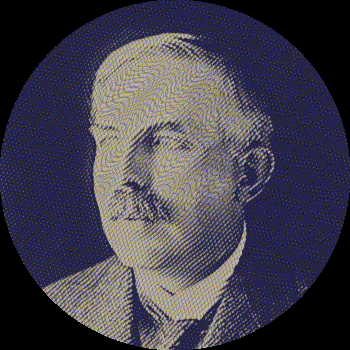
Adapted from an image by George Grantham Bain Collection (Library of Congress) (public domain), via Wikimedia Commons.
Ernest Rutherford
Discovered the atomic nucleus, and showed that radioactive elements turn into others as they decay.
Element
A team led by Georgy Flerov in Dubna made element 104 in 1964, and one led by Albert Ghiorso in Berkeley in 1969. IUPAC found both claims justified, and it was named rutherfordium, after Ernest Rutherford.
Rutherford showed that radioactive atoms turn into other elements as they decay. Follow uranium down its chain.
Watching atoms decay
Uranium-238 halves so slowly that about half of what the Earth formed with is still here. Every atom that does decay sets off a relay of unstable atoms that only stops when it reaches lead.
Half of any sample of U-238 decays every 4.47 billion years, turning into Th-234.
Half-lives passed (1 half-life = 4.47 billion years)
No time passed · 0 half-lives · 100 of 100 atoms left
Each atom decays at a random moment, so no one can say which will go next, but about half of whatever is left goes in every half-life. The dashed curve is the prediction; the solid line is this sample. The new Th-234 atoms decay too, on their own schedule, which the chain below follows.
From U-238 to stable Pb-206: 14 steps
- U-238Uranium4.5 billion yearsαdecays by alpha
- Th-234Thorium24 daysβdecays by beta
- Pa-234mProtactinium1.2 minutesβdecays by beta
- U-234Uranium250,000 yearsαdecays by alpha
- Th-230Thorium75,000 yearsαdecays by alpha
- Ra-226Radium1,600 yearsαdecays by alpha
- Rn-222Radon3.8 daysαdecays by alpha
- Po-218Polonium3.1 minutesαdecays by alpha
- Pb-214Lead27 minutesβdecays by beta
- Bi-214Bismuth20 minutesβdecays by beta
- Po-214Polonium160 microsecondsαdecays by alpha
- Pb-210Lead22 yearsβdecays by beta
- Bi-210Bismuth5 daysβdecays by beta
- Po-210Polonium140 daysαdecays by alpha
- Pb-206Leadstable
Arrows show how each atom decays: α gives off an alpha particle (2 protons and 2 neutrons), β turns a neutron into a proton, γ gives off a gamma ray.
Half-lives and decay modes from the IAEA Live Chart of Nuclides (evaluated ENSDF data). The chain follows each atom’s most common decay; a few steps have rare side branches.
Keep exploring
Where the dates and stories on this page come from; each event on the timeline links to its own source.
- Ernest RutherfordEncyclopaedia Britannica
- RutherfordiumRoyal Society of Chemistry
- Ernest RutherfordWikipedia