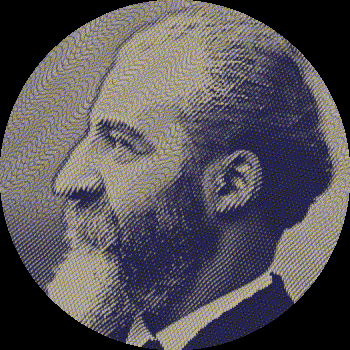
Adapted from an image by sv:Generalstabens litografiska anstalt (public domain), via Wikimedia Commons.
Henri Moissan
Isolated fluorine in 1886.
Element
Chemists knew for decades that fluorides hid an element like chlorine, but every attempt to free it failed, and some made the experimenters ill. In 1886 Henri Moissan succeeded by passing a current through a fluoride solution in platinum apparatus cooled to −50 °C.
Moissan tamed fluorine, the most reactive of the halogens. Compare it with the rest of its group.
The halogens, down the group
Fluorine, chlorine, bromine and iodine sit in the same column, so their atoms all have seven outer electrons and all grab an eighth. But going down the column the atoms get bigger: the colour deepens, they melt and boil at higher temperatures, and they react less fiercely.
- FluorineGasMelts −220 °C · Boils −188 °CGrabs electrons: 3.98
- ChlorineGasMelts −102 °C · Boils −34 °CGrabs electrons: 3.16
- BromineLiquidMelts −7 °C · Boils 59 °CGrabs electrons: 2.96
- IodineSolidMelts 114 °C · Boils 184 °CGrabs electrons: 2.66
At room temperature you can see the whole trend at once: two gases, a liquid and a solid, getting darker down the group. Bigger atoms have more electrons, so the molecules cling to each other more strongly. The bar shows electronegativity: how strongly each atom grabs an extra electron. It falls down the group, and so does reactivity.
Who pushes who out?
The classic school experiment: add a halogen dissolved in water to a solution of a salt of another halogen. A more reactive halogen takes the electron and pushes the less reactive one out, and the colour changes. (Fluorine is left out: it reacts with the water itself.)
Ready to mix
Potassium iodide solution is colourless. The chlorine water is very pale yellow-green.
- Chlorine in water
- Bromine in water
- Iodine in water
Melting and boiling points from the element data. Colours are the familiar look of each substance; in the jars, the vapour above bromine and iodine is drawn stronger as they near their boiling points. Electronegativity on the Pauling scale.
Keep exploring
Where the dates and stories on this page come from; each event on the timeline links to its own source.
- Henri MoissanEncyclopaedia Britannica
- FluorineRoyal Society of Chemistry
- Henri MoissanWikipedia