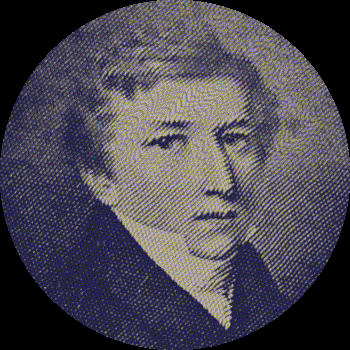
Adapted from an image by Johan Way (public domain), via Wikimedia Commons.
Johan August Arfwedson
Discovered lithium in 1817.
Element
In 1817 Johan August Arfwedson, working in Stockholm, analysed the mineral petalite and found an unknown metal in it, a lighter relative of sodium. He named it lithium, after the Greek for stone, but could not isolate the metal itself.
Arfwedson found lithium, the lightest metal. Compare how it and the other alkali metals react with water.
Drop it in water
Ready to drop a small piece of lithium.
Floats and fizzes steadily, drifting slowly across the water. It stays solid and doesn’t catch fire.
- In water it
- Floats0.534 g/cm³, water is 1
- From the heat it
- Stays solidmelts at 181 °C
- How violent
2Li + 2H₂O → 2LiOH + H₂
Hydrogen gas fizzes off, and the metal hydroxide dissolves, making the water alkaline: a few drops of phenolphthalein indicator turn it pink.
Why it gets more violent down the group
Every alkali metal has one electron in its outer shell, and reacting means giving it away. Further down the group that electron sits in a shell further from the nucleus, shielded by more electrons inside, so it takes less energy to remove and the reaction runs faster.
- Lithium520 kJ/mol
- Sodium496 kJ/mol
- Potassium419 kJ/mol
- Rubidium403 kJ/mol
- Caesium376 kJ/mol
Energy to remove the outer electron (first ionization energy, NIST). Speed isn’t the same as energy: per atom, lithium’s reaction releases slightly more energy than sodium’s, it just releases it slowly. Francium’s value (393 kJ/mol) is a little higher than caesium’s, because of relativistic effects, so it may not be the most violent after all.
Don’t try this at home. Demonstrations use rice-grain-sized pieces behind safety screens; the heavier metals are only shown on video.
Keep exploring
Where the dates and stories on this page come from; each event on the timeline links to its own source.
- Johan August ArfwedsonSvenskt biografiskt lexikon
- LithiumRoyal Society of Chemistry
- Johan August ArfwedsonWikipedia