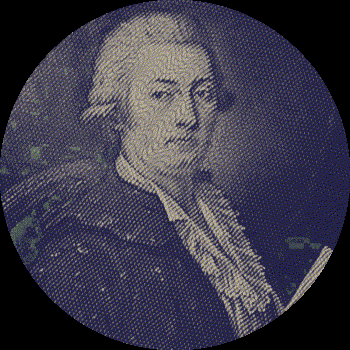
Adapted from an image by Unidentified painter (public domain), via Wikimedia Commons.
Carl Wilhelm Scheele
Discovered oxygen and chlorine in 1774.
Elements
Carl Wilhelm Scheele made oxygen in 1771 but published late; Joseph Priestley made it in 1774 by focusing sunlight on mercury oxide, and published first. Antoine Lavoisier worked out its part in burning and named it oxygen.
In 1774 Carl Wilhelm Scheele, in Uppsala, heated hydrochloric acid with a manganese mineral and got a choking greenish-yellow gas that bleached flowers. It took until 1810 for Humphry Davy to show it was an element; he named it chlorine, from the Greek for pale green.
Scheele called oxygen “fire air”, because things burned so well in it. Explore oxygen and its other forms.
The oxygen you breathe, and its other forms
Oxygen is so familiar we forget it’s there: colourless, odourless, and about a fifth of every breath. But oxygen atoms also team up in threes as ozone, which shields us from the Sun’s ultraviolet. And cooled far enough, oxygen turns into a pale blue liquid that sticks to a magnet.
O₂ Oxygen gas (dioxygen)
- Shape
- Two atoms, joined by a double bond
- In the air
- About 21% of every breath
- Colour and smell
- None as a gas; pale blue as a liquid
- Boils at
- −183 °C
- Magnetic?
- Yes, weakly: two unpaired electrons
The yellow arrows are oxygen’s two unpaired electrons. They make each molecule a tiny magnet: try the demo below.
Cool it to −183 °C: a blue liquid that sticks to a magnet
Pour a liquid past the magnet’s tips.
Each oxygen molecule has two unpaired electrons, the yellow arrows above, which make it a tiny magnet. A magnet pulls them in. Nitrogen’s electrons are all paired, so it doesn’t notice the magnet at all.
The ozone layer: sunscreen for the planet
300 Dobson units3 mm
All the ozone above you, squeezed down to the pressure at sea level, would make a layer only this thick.
- UV-C 100–280 nm
- Stopped completely, high up, by oxygen and ozone.
- UV-B 280–315 nm
- Reaching the ground: A small amount. Mostly stopped by ozone. It causes sunburn, so where ozone is thin, more reaches the ground.
- UV-A 315–400 nm
- Ozone barely touches it: most reaches the ground either way.
In the 1980s scientists found the ozone over Antarctica thinning every spring, eaten away by CFCs from fridges and spray cans. The 1987 Montreal Protocol banned them, and the ozone layer is slowly healing: over Antarctica it should be back to 1980 levels around 2066.
Atoms are drawn smaller than their true size so the shapes are clear. Ozone’s bonds are drawn as one and a half each: its electrons are shared across both bonds. The widths of the ultraviolet arrows are a rough guide based on how ozone absorbs light, not measurements.
Keep exploring
Where the dates and stories on this page come from; each event on the timeline links to its own source.
- Carl Wilhelm ScheeleEncyclopaedia Britannica
- OxygenRoyal Society of Chemistry
- ChlorineRoyal Society of Chemistry
- Carl Wilhelm ScheeleWikipedia