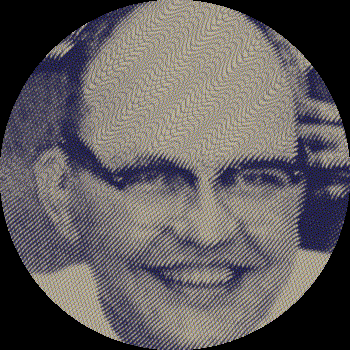
Adapted from an image by James R. Biard (CC BY-SA 4.0), via Wikimedia Commons. This version is shared under the same licence.
Jack Kilby
Engineer at Texas Instruments who built the first integrated circuit, and shared the 2000 Nobel Prize in Physics.
Element
At Texas Instruments, Jack Kilby tested a sliver of germanium carrying a transistor, resistors and a capacitor: the first integrated circuit.
Kilby's first chip was a sliver of doped germanium. Dope a semiconductor and watch it conduct.
Doping: make it conduct
Pure germanium barely conducts: every outer electron is locked in a bond. Swap in a few atoms of another element, called doping, and it starts to conduct. Every computer chip is built this way.
- −Free electron
- +Hole: a bond missing an electron
- P⁺ B⁻ Dopant atoms that gave or took one electron
Pick phosphorus or boron, then click an atom to swap it in (or use “Add one”). Click it again to swap it back.
Pure germanium
- Free electrons
- 1
- Holes
- 1
- Current
- None: switch the battery on
Every outer electron is locked in a bond, so there’s almost nothing free to carry a current. Germanium is a little different: its bonds are weaker, so room-temperature warmth alone frees a few electrons, leaving holes behind. That gives a small trickle of current even when pure.
Where doping matters
- Every chip
A computer chip holds billions of tiny switches called transistors. Each is a pattern of n-type and p-type silicon, made by doping different areas.
- Solar cells
A solar panel is a sheet of n-type silicon on p-type silicon. Light frees electrons near the join, and the join pushes them one way: a current.
- Germanium came first
The first transistor, built in 1947, was made of germanium. Silicon took over because its bonds are stronger (a band gap of 1.12 eV against 0.66), so it keeps working when it gets hot.
The crystal is drawn flat: really each atom bonds to four neighbours in 3D, as in diamond. Doping is hugely exaggerated: chips use about one dopant atom per million atoms or fewer. Carrier speeds use room temperature mobilities (germanium: electrons 3,900, holes 1,900 cm²/V·s; Sze, Physics of Semiconductor Devices). The meter shows current in relative units.
Keep exploring
Where the dates and stories on this page come from; each event on the timeline links to its own source.
- Jack KilbyEncyclopaedia Britannica
- September 12: Successful test of the first integrated circuitComputer History Museum
- Jack KilbyWikipedia