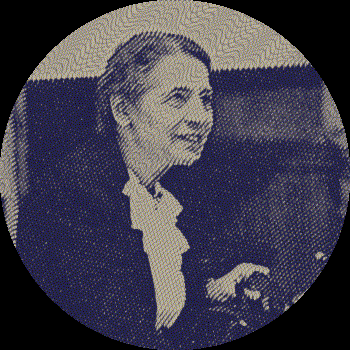
Adapted from an image by Smithsonian Institution (public domain), via Wikimedia Commons.
Lise Meitner
Physicist who, with her nephew Otto Frisch, explained how a nucleus can split in two, and gave the process its name: fission.
On the timeline
Uranium splits
In Berlin, Otto Hahn and Fritz Strassmann found barium among the products of uranium bombarded with neutrons. Lise Meitner and Otto Frisch explained it weeks later: the nucleus had split in two.
The discovery of fissionUS Department of Energy
Elements
In 1913 Kazimierz Fajans and Oswald Göhring found a short-lived element between thorium and uranium. In 1918 Lise Meitner and Otto Hahn, in Berlin, found a long-lived form and named it protoactinium, later shortened to protactinium, because it decays into actinium.
In 1982 a team led by Peter Armbruster and Gottfried Münzenberg at GSI, in Darmstadt, fired iron at bismuth for a week and detected a single atom of element 109. It was named meitnerium, after Lise Meitner.
Meitner and her nephew Otto Frisch explained how a uranium nucleus splits in two. Split one yourself.
Splitting the atom
A uranium-235 nucleus that catches a slow neutron can split in two, releasing energy and 2 or 3 new neutrons. If those neutrons split more nuclei, the process feeds itself: a chain reaction. It’s what powers nuclear power stations.
One split, step by step
1. A slow neutron approaches
A neutron, with no electric charge, drifts towards a uranium-235 nucleus: 92 protons (red) and 143 neutrons (grey).
Proton NeutronDrag to rotate
Where the energy comes from: E = mc²
Weigh the neutron and the uranium atom, then weigh everything that comes out. Masses are in atomic mass units (u), about the mass of one proton.
- Neutron1.008665 u
- Uranium-235235.043928 u
Every particle counted and weighed. Now split it and weigh the pieces.
Split every atom in 1 kg of uranium-235 this way and just 0.79 g of mass disappears, less than a paper clip. That’s about 71 trillion joules, as much as burning about 3,000 tonnes of coal.
The chain reaction
Fire a neutron into the fuel. Add control rods to soak up neutrons, or change how much of the fuel is uranium-235, and try to keep the reaction steady, like a reactor operator.
Fire a neutron to start.
- Splits
- 0
- Neutrons flying
- 0
- Uranium-235 left
- 0
A toy model: a real reactor holds billions of billions of atoms, and water or graphite slows the neutrons so uranium-235 can catch them. Natural uranium is only 0.7% uranium-235; power-station fuel is enriched to a few percent. Barium-141 and krypton-92 are one common pair of fragments among many. Atomic masses from the 2020 Atomic Mass Evaluation (IAEA). Averaged over all the ways it can split, and counting energy the fragments give off later, a fission releases about 200 MeV. Coal taken as 24 MJ/kg.
Keep exploring
Where the dates and stories on this page come from; each event on the timeline links to its own source. Britannica gives 7 November 1878, the date Meitner herself used; the Vienna birth register is sometimes read as 17 November.
- Lise MeitnerEncyclopaedia Britannica
- ProtactiniumRoyal Society of Chemistry
- MeitneriumRoyal Society of Chemistry
- Lise MeitnerWikipedia