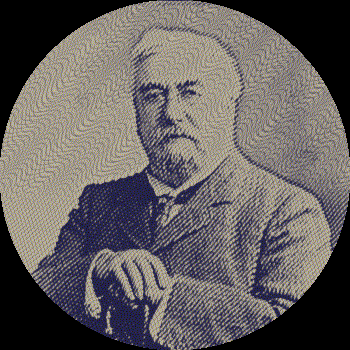
Adapted from an image by not indicated (public domain), via Wikimedia Commons.
Norman Lockyer
English astronomer who studied the Sun's spectrum, and founded the journal Nature.
Element
Watching a total eclipse from Guntur in India, Pierre Janssen saw a yellow line in the Sun's spectrum that matched no known element. Norman Lockyer saw it too, and named the element helium.
Lockyer named helium after the Sun, where its yellow line was first seen. Find it among helium's other lines.
A fingerprint made of light
In 1868, astronomers watching a solar eclipse saw a yellow line at 587.6 nm that matched no element known on Earth. It was named helium, after Helios, the Greek word for the Sun, and wasn’t found on Earth until 1895.
Electrons race through the tube and crash into helium atoms, knocking the atoms’ own electrons up to higher energy levels. As those fall back, the atoms give off light only at the exact wavelengths below, so each gas glows its own colour.
The five gases’ visible lines side by side: each pattern is a fingerprint. Choose one to see it in detail below.
Click a line to see where it comes from.
388.9 nmviolet
An electron falls from the 3p level down to the 2s level. It loses 3.19 eV of energyAn electronvolt (eV) is a tiny unit of energy used for atoms: the energy one electron gains crossing 1 volt. A particle of visible light carries between about 1.7 eV (red) and 3.3 eV (violet). and gives it off as one particle of violet light. Bigger drops give bluer light.
The strongest visible lines of neutral helium from the NIST Atomic Spectra Database. Line brightness follows NIST’s relative intensities, which only compare lines of the same element. Colours are approximate, and lamp colours are as they look to the eye.
Keep exploring
Where the dates and stories on this page come from; each event on the timeline links to its own source.
- Norman LockyerEncyclopaedia Britannica
- HeliumRoyal Society of Chemistry
- Total Solar Eclipse of 1868 August 18NASA
- Norman LockyerWikipedia