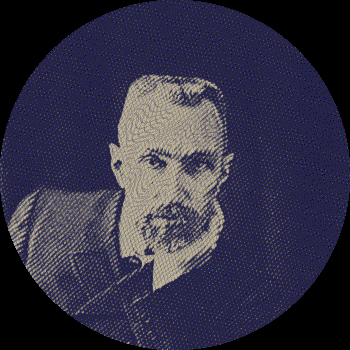
Adapted from an image by Dujardin (public domain), via Wikimedia Commons.
Pierre Curie
Physicist who studied magnetism and crystals before turning to radioactivity with Marie Curie; they shared the 1903 Nobel Prize in Physics with Henri Becquerel.
Elements
- 189884PoPolonium
- 189888RaRadium
- 194496CmCurium
The Curies found radium by its radioactivity. Watch radium atoms decay, one at a time.
Watching atoms decay
Marie and Pierre Curie discovered radium in 1898, in uranium ore. It is there because radium-226 is one stop on uranium-238’s decay chain, constantly being made and destroyed.
Half of any sample of Ra-226 decays every 1,600 years, turning into Rn-222.
Half-lives passed (1 half-life = 1,600 years)
No time passed · 0 half-lives · 100 of 100 atoms left
Each atom decays at a random moment, so no one can say which will go next, but about half of whatever is left goes in every half-life. The dashed curve is the prediction; the solid line is this sample. The new Rn-222 atoms decay too, on their own schedule, which the chain below follows.
From U-238 to stable Pb-206: 14 steps
- U-238Uranium4.5 billion yearsαdecays by alpha
- Th-234Thorium24 daysβdecays by beta
- Pa-234mProtactinium1.2 minutesβdecays by beta
- U-234Uranium250,000 yearsαdecays by alpha
- Th-230Thorium75,000 yearsαdecays by alpha
- Ra-226Radium1,600 yearsαdecays by alpha
- Rn-222Radon3.8 daysαdecays by alpha
- Po-218Polonium3.1 minutesαdecays by alpha
- Pb-214Lead27 minutesβdecays by beta
- Bi-214Bismuth20 minutesβdecays by beta
- Po-214Polonium160 microsecondsαdecays by alpha
- Pb-210Lead22 yearsβdecays by beta
- Bi-210Bismuth5 daysβdecays by beta
- Po-210Polonium140 daysαdecays by alpha
- Pb-206Leadstable
Arrows show how each atom decays: α gives off an alpha particle (2 protons and 2 neutrons), β turns a neutron into a proton, γ gives off a gamma ray.
Half-lives and decay modes from the IAEA Live Chart of Nuclides (evaluated ENSDF data). The chain follows each atom’s most common decay; a few steps have rare side branches.
Keep exploring
Where the dates and stories on this page come from; each event on the timeline links to its own source.
- Pierre CurieEncyclopaedia Britannica
- Adloff, The Centenary of a Controversial Discovery (2011)IUPAC Chemistry International
- PoloniumRoyal Society of Chemistry
- RadiumRoyal Society of Chemistry
- Pierre CurieWikipedia