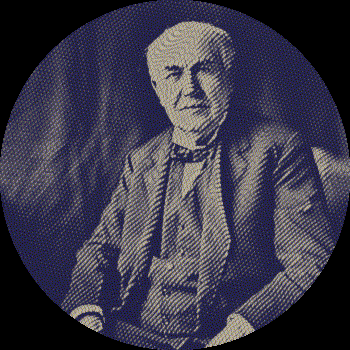
Adapted from an image by Louis Bachrach, Bachrach Studios, restored by Michel Vuijlsteke (public domain), via Wikimedia Commons.
Thomas Edison
American inventor of the phonograph and a practical electric lamp, with more than a thousand US patents.
Element
At Menlo Park, Thomas Edison's team lit a lamp with a filament of carbonised cotton thread in a vacuum, and it burned for over 13 hours. It was the first lamp with real commercial promise.
Edison's first lamps glowed with carbon filaments; tungsten took over in the 1900s. Turn up the current on a filament.
Turn up the current on a light bulb
An old-style light bulb is just a coil of tungsten wire. Push a current through it and the wire heats up until it glows. Turn up the current and watch the colour change, then see how close the filament gets to melting.
- Current
- 0.00 A
- Resistance
- 57 Ω
- Visible light
- almost none
Switched off. Turn up the current to heat the filament.
Cold, the filament’s resistance is only about 57 Ω; glowing, it’s about 882 Ω. So for a split second after you switch on, around 15 times the normal current rushes in, which is why bulbs usually fail at the moment you switch them on.
Why tungsten?
- Gold1,064 °C
- Copper1,085 °C
- Iron1,538 °C
- Platinum1,768 °C
- Tantalum3,017 °C
- Osmium3,033 °C
- Tungsten3,422 °C
The bars show each metal’s melting point; the orange line is the filament now. A normal bulb at 2,427 °C would have melted gold, copper, iron and platinum long ago. Only a handful of metals survive it, and tungsten melts hottest of all.
Even at room temperature the filament gives out a faint glow, but it’s all far infrared: the peak is off the right of the chart.
A century of filaments
- Edison’s carbon, 1879
The first practical bulbs used carbon threads. Carbon doesn’t melt, but it slowly boils away, blackening the glass, so the filaments had to run cooler and redder.
- Osmium, tantalum, tungsten
Osmium (1898) and tantalum (1902) came next. Tungsten arrived in 1904, but it was brittle until William Coolidge found a way to draw it into fine wire; by 1911 it was in bulbs everywhere.
- Why they were phased out
Even at its best, a glowing wire turns only a few percent of its power into light. LEDs give the same light for a fraction of the energy, so many countries have banned most filament bulbs.
A 60 W, 230 V bulb, calibrated to a typical 2,700 K at its rated current. The temperature comes from balancing the electrical heating against the heat radiated, using tungsten’s measured resistivity (Desai et al., 1984); it ignores the heat lost through the supports. Real filaments radiate a little less than an ideal blackbody, and because our eyes are most sensitive to green, a real 60 W bulb’s efficiency measured by brightness is only about 2%. Melting points from the element data. Bulb history from Wikipedia.
Keep exploring
Where the dates and stories on this page come from; each event on the timeline links to its own source.
- Thomas EdisonEncyclopaedia Britannica
- The carbon-filament lampThomas A. Edison Papers, Rutgers
- Thomas EdisonWikipedia