Hydrogen
One proton defines hydrogen. A neutral atom has just one electron. The simplest element connects the chemistry of water with the nuclear reactions that power the Sun.
A stylized shell model. Electrons are quantum objects, not particles following these literal paths. Sizes and motion are illustrative.
At a glance
- Atomic number
- 1
- Atomic mass
- 1.008 u
- Phase
- Gas
- Density
- 0.08988 g/L
- Melting point
- 13.99 K
- Boiling point
- 20.271 K
- First ionization energy
- 1,312 kJ/mol
- Electronegativity
- 2.2
- Electron affinity
- 72.769 kJ/mol
- Molar heat capacity
- 28.836 J/(mol·K)
- Period
- 1
- Appearance
- colorless gas
Conditions and isotopes affect measured properties. Some properties of short-lived elements are predicted. Electronegativity uses the Pauling scale.
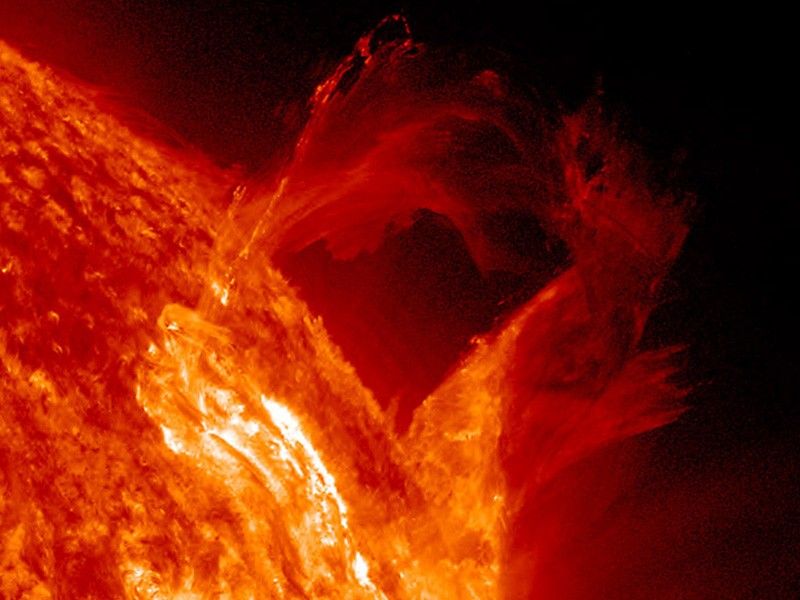
The fuel of a star
A solar prominence observed by the Solar Dynamics Observatory. The Sun’s energy originates much deeper, in its core.
Image: Solar Dynamics Observatory / NASAFrom hydrogen to helium
At the Sun’s core, extreme temperatures and pressure allow hydrogen nuclei to fuse into helium. These nuclear reactions release the energy that eventually reaches us as sunlight.
Explore the Sun with NASAWhat makes an element?
The proton count is the defining feature. Every hydrogen nucleus has one proton. Isotopes can have different neutron counts, and ions can gain or lose electrons, without becoming a different element.
Royal Society of Chemistry · HydrogenKeep exploring
Explore the stories, imagery, and reference data in more depth. Properties with no value in the reference are marked unavailable.