Tin
Tin is a chemical element with the symbol Sn (for Latin:stannum) and atomic number 50. It is a main group metal in group 14 of the periodic table. Tin shows a chemical similarity to both neighboring group-14 elements, germanium and lead, and has two possible oxidation states, +2 and the slightly more stable +4.
At a glance
- Atomic number
- 50
- Atomic mass
- 118.7107 u
- Phase
- Solid
- Density
- 7.365 g/cm³
- Melting point
- 505.08 K
- Boiling point
- 2,875 K
- First ionization energy
- 708.6 kJ/mol
- Electronegativity
- 1.96
- Electron affinity
- 107.2984 kJ/mol
- Molar heat capacity
- 27.112 J/(mol·K)
- Period
- 5
- Appearance
- silvery-white (beta, β) or gray (alpha, α)
Conditions and isotopes affect measured properties. Some properties of short-lived elements are predicted. Electronegativity uses the Pauling scale.
Tin’s orbitals use a hydrogen-like approximation. Every orbital of each visible subshell is shown: in Shapes as the surface holding half its probability, with light and dark shades for opposite signs of the wavefunction; in Cloud as dots where its electrons are likely to be. Sizes are stepped by shell, like the Shell model.
36 is the [Kr] core total across four shells.
Preparing the orbital view…
50 protons70 neutrons
Tin-120: its most common form in nature, or its longest-lived if it has none. The nucleus is drawn far too big: it’s about 100,000 times smaller than the atom.
Turn up the heat
A step of 1 K is the same size as 1 °C, so the two scales are always 273.15 apart. Fahrenheit is different: its degrees are smaller and it starts elsewhere, so water freezes at 273.15 K, 0 °C and 32 °F.25 °C · 77 °FSolid
At this temperature, tin is a solid.
At normal atmospheric pressure (1 atm). The temperature scale is logarithmic. The particle box is schematic: real samples hold vastly more atoms, and spacing and speeds are not to scale.
Pull the electrons off
SnNeutral atom · no charge
A neutral tin atom. Removing its first electron takes 709 kJ/mol.
Tin’s outer shell holds 4 electrons. Electron 5 is the first from an inner shell: it sits closer to the nucleus with less shielding, so removing it takes 1.9× as much energy as the one before. Each dashed line on the chart marks another jump, into a shell even closer to the nucleus.
What does this tell us?
- The jumps let you count electrons. Between the dashed lines there are 4, then 18, then 18, then 8, then 2 bars. Read backwards, that’s 2, 8, 18, 18, 4: the same electrons per shell as the shell model above. Jumps like these are part of the evidence that shells exist.
- The 4 electrons before the first big jump are tin’s valence electrons, the ones it uses in chemical reactions. That’s why tin sits in group 14: every element in the group has the same number of outer electrons, so they react in similar ways.
- Within a shell the steps rise gently. Each electron removed leaves fewer electrons pushing the others away, while the nucleus pulls just as hard, so the next one is held a little more tightly.
Show the values as a table
| Electron | Shell | Energy (kJ/mol) | × previous | Value |
|---|---|---|---|---|
| 1 | 5 | 709 | – | Measured |
| 2 | 5 | 1,412 | 2 | Measured |
| 3 | 5 | 2,943 | 2.1 | Measured |
| 4 | 5 | 3,931 | 1.3 | Measured |
| 5 | 4 | 7,432 | 1.9 | Measured |
| 6 | 4 | 9,070 | 1.2 | Calculated |
| 7 | 4 | 10,893 | 1.2 | Calculated |
| 8 | 4 | 13,026 | 1.2 | Calculated |
| 9 | 4 | 15,052 | 1.2 | Calculated |
| 10 | 4 | 17,753 | 1.2 | Calculated |
| 11 | 4 | 20,069 | 1.1 | Calculated |
| 12 | 4 | 22,385 | 1.1 | Calculated |
| 13 | 4 | 24,893 | 1.1 | Calculated |
| 14 | 4 | 27,209 | 1.1 | Calculated |
| 15 | 4 | 36,568 | 1.3 | Calculated |
| 16 | 4 | 39,270 | 1.1 | Calculated |
| 17 | 4 | 42,164 | 1.1 | Calculated |
| 18 | 4 | 44,962 | 1.1 | Calculated |
| 19 | 4 | 48,822 | 1.1 | Calculated |
| 20 | 4 | 51,813 | 1.1 | Calculated |
| 21 | 4 | 58,663 | 1.1 | Calculated |
| 22 | 4 | 61,977 | 1.1 | Estimated |
| 23 | 3 | 108,739 | 1.8 | Calculated |
| 24 | 3 | 115,300 | 1.1 | Calculated |
| 25 | 3 | 122,440 | 1.1 | Calculated |
| 26 | 3 | 129,966 | 1.1 | Calculated |
| 27 | 3 | 137,106 | 1.1 | Calculated |
| 28 | 3 | 145,500 | 1.1 | Calculated |
| 29 | 3 | 153,991 | 1.1 | Calculated |
| 30 | 3 | 161,709 | 1.1 | Calculated |
| 31 | 3 | 170,104 | 1.1 | Calculated |
| 32 | 3 | 177,919 | 1 | Calculated |
| 33 | 3 | 200,111 | 1.1 | Estimated |
| 34 | 3 | 206,681 | 1 | Estimated |
| 35 | 3 | 214,873 | 1 | Estimated |
| 36 | 3 | 224,425 | 1 | Estimated |
| 37 | 3 | 235,714 | 1.1 | Estimated |
| 38 | 3 | 241,117 | 1 | Estimated |
| 39 | 3 | 259,256 | 1.1 | Estimated |
| 40 | 3 | 266,540 | 1 | Estimated |
| 41 | 2 | 619,532 | 2.3 | Estimated |
| 42 | 2 | 639,794 | 1 | Estimated |
| 43 | 2 | 661,793 | 1 | Estimated |
| 44 | 2 | 683,116 | 1 | Estimated |
| 45 | 2 | 726,631 | 1.1 | Estimated |
| 46 | 2 | 751,621 | 1 | Calculated |
| 47 | 2 | 781,821 | 1 | Estimated |
| 48 | 2 | 801,499 | 1 | Calculated |
| 49 | 1 | 3,305,312 | 4.1 | Calculated |
| 50 | 1 | 3,395,560 | 1 | Calculated |
Successive ionization energies of gas-phase atoms and ions from the NIST Atomic Spectra Database. Solid bars are measured; hatched bars were estimated from nearby measurements or calculated from quantum theory, as is usual for highly charged ions. Electrons are taken from the outermost shell first, a simplification: electrons in different subshells of the same shell also differ in energy. On the log scale each gridline is 10 times the one below.
Tin that crumbles in the cold
Tin has two solid forms. Above 13.2 °C it is white tin: the shiny, bendable metal we know. Below that, grey tin is the stable form, a brittle grey powder. The switch is slow, but once it starts it spreads like a disease, which is why it’s called tin pest.
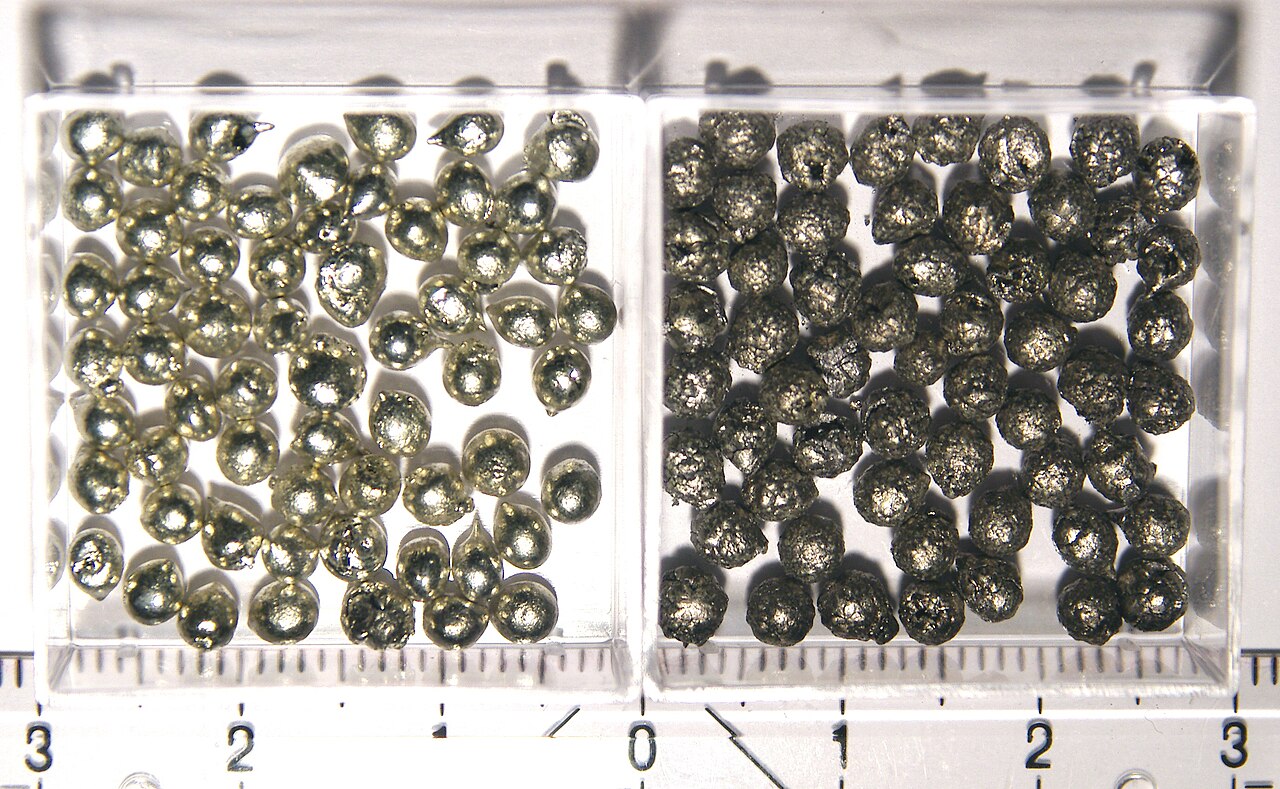
Very pure tin as white tin (left) and grey tin (right). Same element, same beads: the grey ones have crumbled into a dull crust. The ruler is in centimetres.
Photo: Alchemist-hp (pse-mendelejew.de), CC BY-SA 3.0 DE, via Wikimedia Commons20 °C293 K
White tin β-tin
- Arrangement
- Body-centred tetragonal
- Close neighbours
- 4 close, 2 a little further
- Density
- 7.29 g/cm³
- Conducts electricity
- Well: it is a metal
- What it’s like
- Soft, shiny and easy to bend
Leave a tin organ pipe in the cold
Tin pest at 20 °CNone: white tin is stable here
Colder gives the switch to grey tin more of a push, but atoms also move more sluggishly in the cold. The two effects balance out at about −30 to −40 °C, where tin pest spreads fastest.
At 13.2 °C and above, white tin is stable. Slide below it to give tin pest a chance.
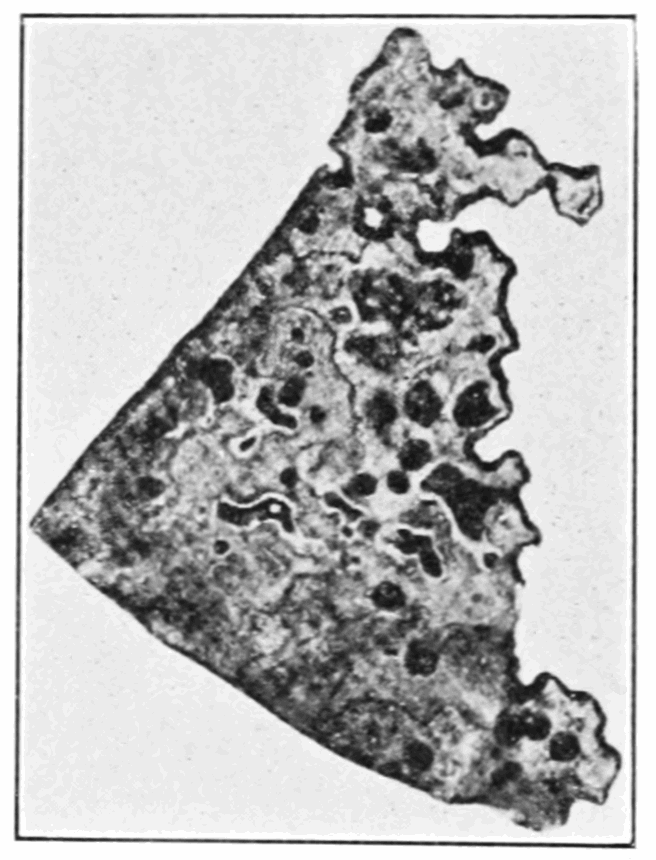
The real thing, photographed in 1913: grey warts spreading across a sheet of tin and eating away its edges.
Photo: Popular Science Monthly, 1913, Public domain, via Wikimedia CommonsWhere tin pest turns up
- Organ pipes
Old organ pipes are often made of tin. In unheated churches through cold winters, some have grown grey warts and crumbled. Reports go back to 1467, in Lübeck, Germany.
- Napoleon’s buttons?
A popular story says tin buttons fell apart on French uniforms in the Russian winter of 1812. Historians doubt it: in lab tests pure tin takes about 18 months to be badly damaged, more than twice as long as the campaign.
- Your phone
Modern solder is mostly tin, now that lead is banned from most electronics. Makers add a pinch of other metals, such as bismuth, to stop tin pest.
At normal pressure. Both forms are drawn in the same tall box, so you can watch one turn into the other: grey tin’s diamond pattern is white tin’s cell stretched taller and narrower. In real tin the change starts at a few spots and spreads, rather than every cell switching at once, and it can take months or years to begin. The speed curve is a simplified shape, not measured rates.
How does it compare?
Density
7.37 g/cm³45th highest of 99
Melting point
505 K25th lowest of 96
Boiling point
2,875 K45th highest of 97
Electronegativity
1.9633rd highest of 96
First ionization energy
709 kJ/mol48th highest of 99
Elements 1–99 from the reference data; heavier elements are left out because only a few atoms have ever been made, so their bulk properties are predictions. First ionization energies come from NIST. Density uses a logarithmic scale, because gases are around a thousand times less dense than solids; gas densities are at 0 °C and 1 atm. Melting and boiling points are at normal pressure. Everyday temperatures and light sources in the pictures are approximate. Hover over a dot to see the element, or click it to compare.
Keep exploring
Explore the stories, imagery, and reference data in more depth. Properties with no value in the reference are marked unavailable.
- TinRoyal Society of Chemistry
- TinWikipedia
- Quantum numbers and electron configurationsPurdue
- Hydrogenic wavefunctionsNIST
- Ionization energiesNIST Atomic Spectra Database